
.
May I ask, what is the current status of ‘starling’?
.
Will Starling currently develop new features?
.
Is’ starling 'or just fixing error issues sufficient?
.
If the AS3 version of Starling gets new features or bugfixes, we try to merge those into the Haxe version. Daniel Sperl, the creator of Starling, is no longer actively developing new features. However, he has been responsive to community contributions, and he has merged some interesting new features submitted as PRs on GitHub.
1 Like
.
‘Haxe Starling’ surprisingly does not independently update new features and fix errors
.
Surprisingly relying on ‘AS3 Starling’
.
AS3 Starling is said to have stopped updating and fixing errors.
.
Such a great framework has stopped updating ..Feeling of loss!
.
Does using ‘starling’ now have any impact or are there any restrictions for now?
.
How many people are using ‘starling’?
It seems that ‘openfl’ has not updated any new features yet?
It is said that “Win10” will stop supporting and updating on the 14th of this month. Will “OpenFL” continue to support “Win10”?
The communities behind the two projects are not mutually exclusive of each other. For example, @joshtynjala above, a key maintainer for OpenFL, has authored recent commits to AS3 Starling, and created and maintains the VS Code AS3, MXML and SWF extensions (@joshtynjala == Bowler Hat).
I’m currently working on tutorials for AS3 + Starling + TexturePacker, and a pull request for Starling for OpenFL that may well add a feature that doesn’t exist in Starling for AS3. Of course, a pull-request may not be accepted, so that’s not a given by any stretch.
It is a mature framework, but yes, development on it is closer to maintenance, rather than advancement of new features.
As @joshtynjala noted though, the projects are open to pull requests, which would add new features. If there’s a feature you believe Starling / OpenFL should have, you might consider making a case for it, or, developing it and submitting it as a pull request. That is really the best way to approach open source projects.
There is really no way to know. The community experienced with Starling is largely a mature one, so you may not see much activity here, because they’re seasoned developers. I for one have only recently become more active in this forum, and yet I’ve been using Starling near exclusively for a decade or so.
Perhaps of help, would be an understanding of what new features you think it needs? That’s where a more productive discussion can be had.
I don’t think it’ll stop working overnight, or even any time soon. I’d anticipate it’d have more to do with the underlying systems, such as SDL. SDL certainly supports Windows 10 (and as far as I can tell, supports all the way back to Windows XP, but I accept correction on that).
1 Like
.
Regarding what was mentioned above, adding new features may just be my aspiration for the future.
.
Because a few days ago, I saw someone in the “Harman Air” community comparing “AS3” to modern game engines. They said that AS3 is a great tool, but it seems outdated compared to modern game engines ..
.
Then, I found that “OpenFL and Starling” haven’t added new features for a long time. Of course, I hope that OpenFL, like modern game engines, will continue to actively update new features. This is just my expectation.
.
Hehe, I’ll just say a few words casually.
.
Last week’s OpenFL update included bug fixes only. We have another OpenFL update with new features planned for next month.
As Bink noted, this statistic can be difficult to determine. However, Haxelib provides the number of downloads for each version of a library. The number of downloads does not necessarily match the number of active users. Sometimes, users don’t update immediately. Sometimes, users may download the same version on multiple computers. Some projects use Continuous Integration (CI) to run automated builds and tests, and that can result in many downloads. However, it can still be a useful stat for making “ballpark” estimates, as we say in English. Basically, it means making estimates that aren’t guaranteed to be accurate, but are close enough to be somewhat useful.
The most recent Starling update was 2.7.1, released in March 2025. There have been 559 downloads since then. Not a lot, actually!
On the other hand, OpenFL 9.4.2 was released only 5 days ago in October 2025, and it already has 1500 downloads. The update before that was released in December 2024 and was downloaded over 100000 times. OpenFL is clearly very popular in the Haxe community!
.
@[joshtynjala]
.
Good morning, I just got up. Thank you very much for your positive response and for providing the download statistics page for ‘Starling and OpenFL’.
.
We have another OpenFL update with new features planned for next month.
.
That’s great
.
I just checked the “starling download page” of “haxelib”, and the download volume of “starling 2.7.1” is only over 600. For global users, this download volume is really too low. Does it prove that the number of “starling” users is really very small ..
I use Starling a lot and I didn’t download 2.7.1 : I’m using the github version directly, I bet I’m not the only one.
There are probably not thousands of people using openfl + starling. I’d love to see that number grow of course but it doesn’t matter much to be honest : is starling fitting my needs ? Yes it is, and that’s what is important to me.
If you are trying to acquire skills that will get you a salary job then it’s quite important to invest into something popular, and haxe is clearly not the best choice in that case.
Otherwise invest your time in something that suits your needs. In my case haxe, openfl and starling fit my needs.
I’ll tell you a story : about 10 years ago I went to an indie game dev meeting. I talked with every group of people asking them what they were working on and what technology they used : every single group was using Unity and they were quite shocked to hear that I was using as3, air and starling.
When I asked them why they chose Unity, none of them could explain : they were just using that because it was popular (and probably because it had reassuring visual tools I guess). They were all doing 2D games, and they didn’t know that starling’s performance was much better.
I was the only one with a working prototype, which was running smoothly on an iPad4. The creator of the highly successful game “Out There” was there, he had started his own publishing company, and he was interested in publishing my game.
Another story : a few years before that meeting I went to my first game jam (an IRL one). I was the only as3 programmer, I tried to join with the game designers who had interesting pitches but they turned me down because “flash”. I ended up in a team where I was the only programmer, and at the end of the weekend we had a fully working platformer game prototype running on starling + box2d with a level editor (Flash) running flawlessly at 60fps.
We unofficially (there was no official ranking) “won” the game jam, the creator of “Alone in the Dark” (Frederic Raynal) was there, and he came to me to ask about the tech we used 
3 Likes
Your stories reflect my experiences too @Matse. When it comes to producing something fast and performant, the AIR SDK is really powerful.
Some years ago when I was working in experiential marketing as a tech lead, we were tasked with delivering a whole series of interactive experiences for a popular global tourist attraction. We normally developed everything in-house, almost exclusively using AIR. Because of the size of the project though, one of the interactives was outsourced to a local tech/development studio. The app they were to develop allowed users to digitally apply makeup to their own faces which were tracked in realt-ime, displayed using a mirror that was actually a TV. After weeks, this outsourced studio delivered a clunky .NET based app that failed to meet expectations. It looked like people had sprite blobs slapped on their faces, that tracked lazily with their face, not makeup.
The bosses were stressed, as we were out of time, with the experiences being physically installed!
In the space of a day or two, while also travelling interstate to install these experiences, I built the entire app in AIR from scratch again, ditching the outsourced version. It delivered a far better interactive experience and the bosses were very happy.
There are other stories like that too, like needing to turn around a game in the space of a night for one of our international offices.
“AIR” in the broader business gained the reputation for being powerful rapid development tool, and our office took the lead globally in terms of technical expertise. Noting public GitHub repositories, I could also see the competition (other experiential marketing agencies), leveraging AIR too, so we weren’t alone with realising the capabilities of AIR.
Now the thing is, when Adobe ended Flash, the huge community that had been in the ActionScript 3.0 / AIR / Flash ecosystem fragmented. Many I suspect jumped to Unity. But what’s changed? AIR is still actively developed and supported and remains just as viable an option as it did 6 years ago. OpenFL also provides a familiar and powerful alternative, that respects the AIR ecosystem, with a fair amount of cross-over between the communities.
3 Likes
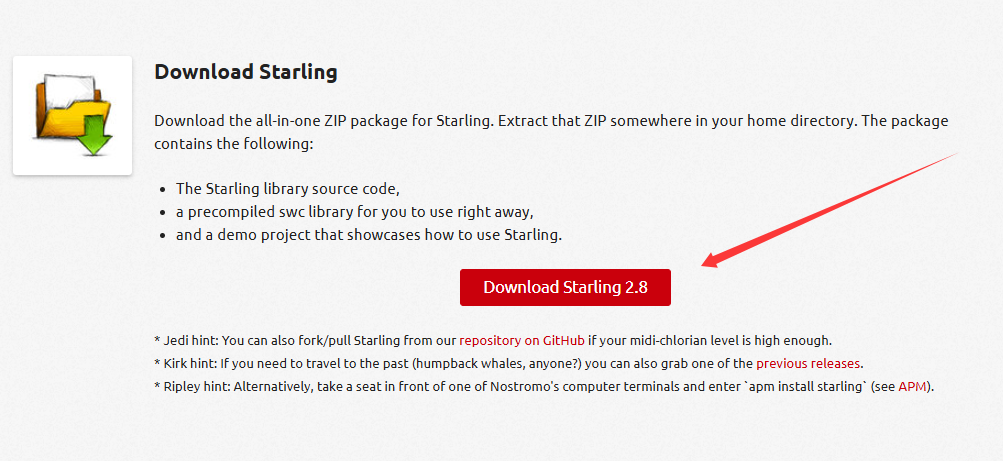
I am really happy today and I want to share this joy with everyone. The “Starling AS3” version has been updated to “2.8” version today
1 Like
Today, version 2.8 of “Starling AS3” has been released, and we are very much looking forward to the update of “Starling OpenFL” version. Thank you.
Sorry, I may have said the wrong thing earlier. I just prompted that the “Starling AS3” version has been updated. I was just asking when the “Starling OpenFL” version will be updated? Thank you
@Bink I bet there are tons of those stories !
I disagree a bit about air current status : it seems to me that a lot depends on distriqt’s ANEs. I might be wrong but I think distriqt is just Michael : he’s a great guy doing an awesome job, but it doesn’t seem very healthy to me that a lot of the AIR ecosystem depends on a single individual.
I find it quite surprising (and a bit sad) that Unity still seems to have so many users despite their evil move a few years ago : yes they took a step back, but I wouldn’t have any trust in a company capable of doing that in the first place.
@785597448 about starling 2.8 I’ll take care of the update after I release my lib if no one does it before, Josh’s time is better spent on lime, openfl and feathers 
2 Likes
You might raise a fair point regarding the Distriqt ANE’s, perhaps touching on a broader issue. I hadn’t actually used Distriq ANE’s before, but that probably has more to do with the sector I worked in. When it comes to classic phone app development, I can see how they’d be a valuable resource.
The broader issue though, is the ActionScript 3.0 / AIR / Flash ecosystem that fragmented. That included plugin and ANE developers, who provided a valuable service of filling in the gaps. Hardware vendors used to provide AIR extensions themselves, such was the popularity of AIR once upon a time. This is what a community around any given project provides, and it was once pumping for ActionScript 3.0 / AIR / Flash. There’s still a community, but it pains me to admit, it’s just not what it used to be.
Yeah, that was fairly shocking news when that hit. I counted myself fortunate that I’d chosen not to sink my time into Unity (or any other proprietary solution post Adobe ceasing Flash).